AI Caretaker
A voice-activated in-home safety system for people living with dementia. It listens, talks, senses emergencies, and keeps families connected — without ever asking the patient to press a button or remember a command.
A blue Ring notification would flash across my phone in the middle of class, and my stomach would drop. My grandfather's dementia led him to wander outside alone. I learned to recognize the click of the front door lock from my bedroom and race downstairs before he got too far.
Life Alert needed him to recognize an emergency. The GPS watch couldn't help inside the house. “Hey Alexa” was a phrase he could never remember. The burden-free solution I needed simply didn't exist — so over three years, I built it.
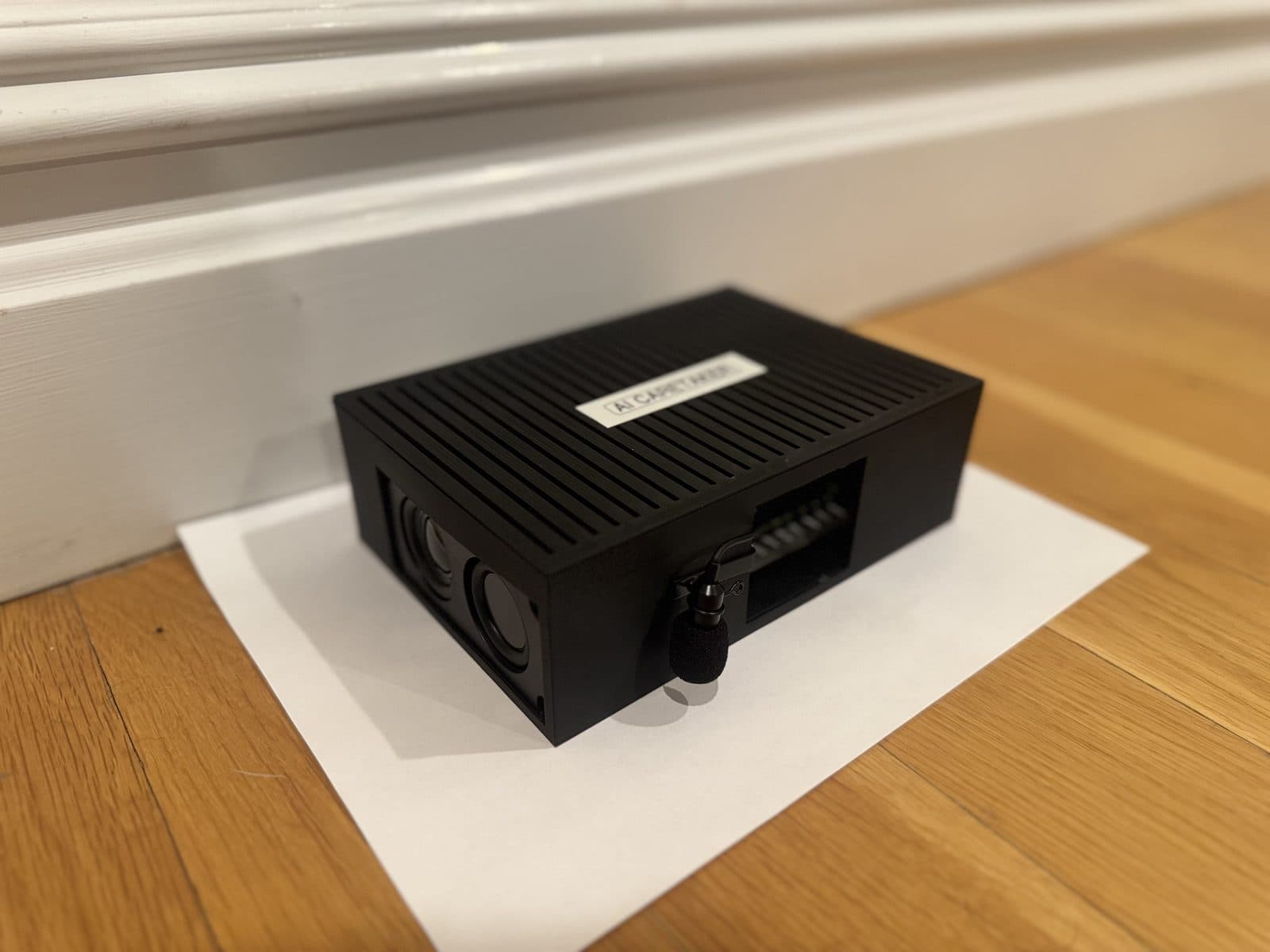
The first time I placed the device beside him, he looked at it and asked, “Did I go for my walk today?” It searched his activity log and answered, “Yes, you went for a walk this afternoon.” He went quiet, nodded, and settled back into his chair. Finally, something listened to his every word.
“Instead of asking people to adapt to technology, I could build technology that meets them where they are.”
What it does
Natural conversation
No wake words, no buttons, no apps — the exact barriers that make a device like Alexa unusable for someone with dementia. The patient just talks; the Pi captures and transcribes it, and GPT-4o-mini replies in a calm, simple voice that keeps them company through the day.
Emergency detection & alerts
Every statement is classified for danger — a fall, chest tightness, nighttime confusion. When the model flags an emergency it assigns a 0–100 severity score and fires an SMS to the caregiver with the transcript and severity — no button-press or request for help required from the patient.
Medication & activity logging
The same model quietly extracts structured data from ordinary conversation — whether a meal, walk, or medication was mentioned, and when — and logs it. No manual input from someone who may not remember to give it, and no interface for them to learn.
Caregiver dashboard
A TypeScript dashboard backed by Supabase gives family a remote window into everything: conversation history, flagged emergencies with severity, medication and activity logs, and timestamps — turning scattered, all-day worry into reviewable information.
How it works
Four components, one seamless loop — from a spoken word in the living room to a caregiver's phone.
Listen
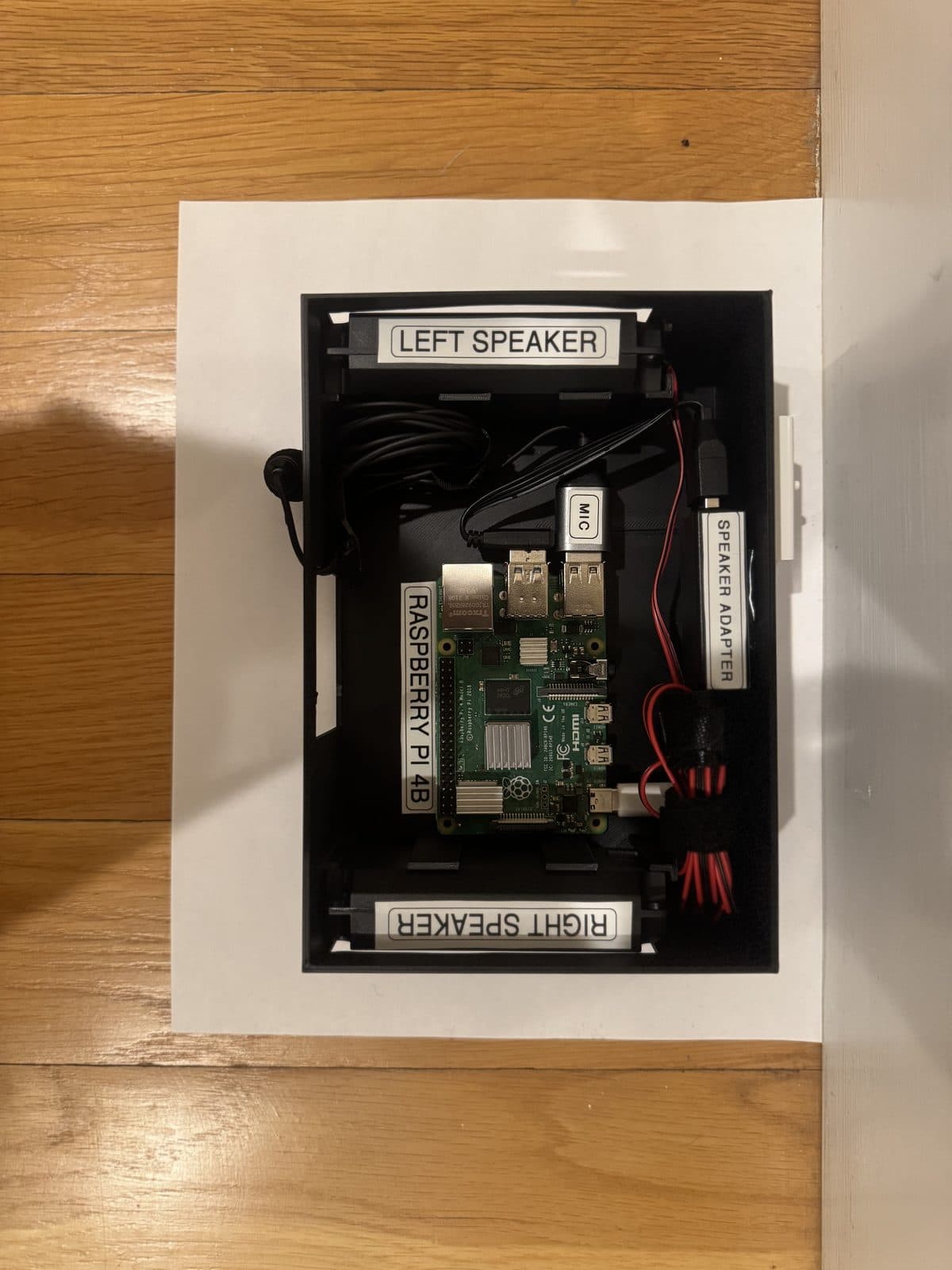
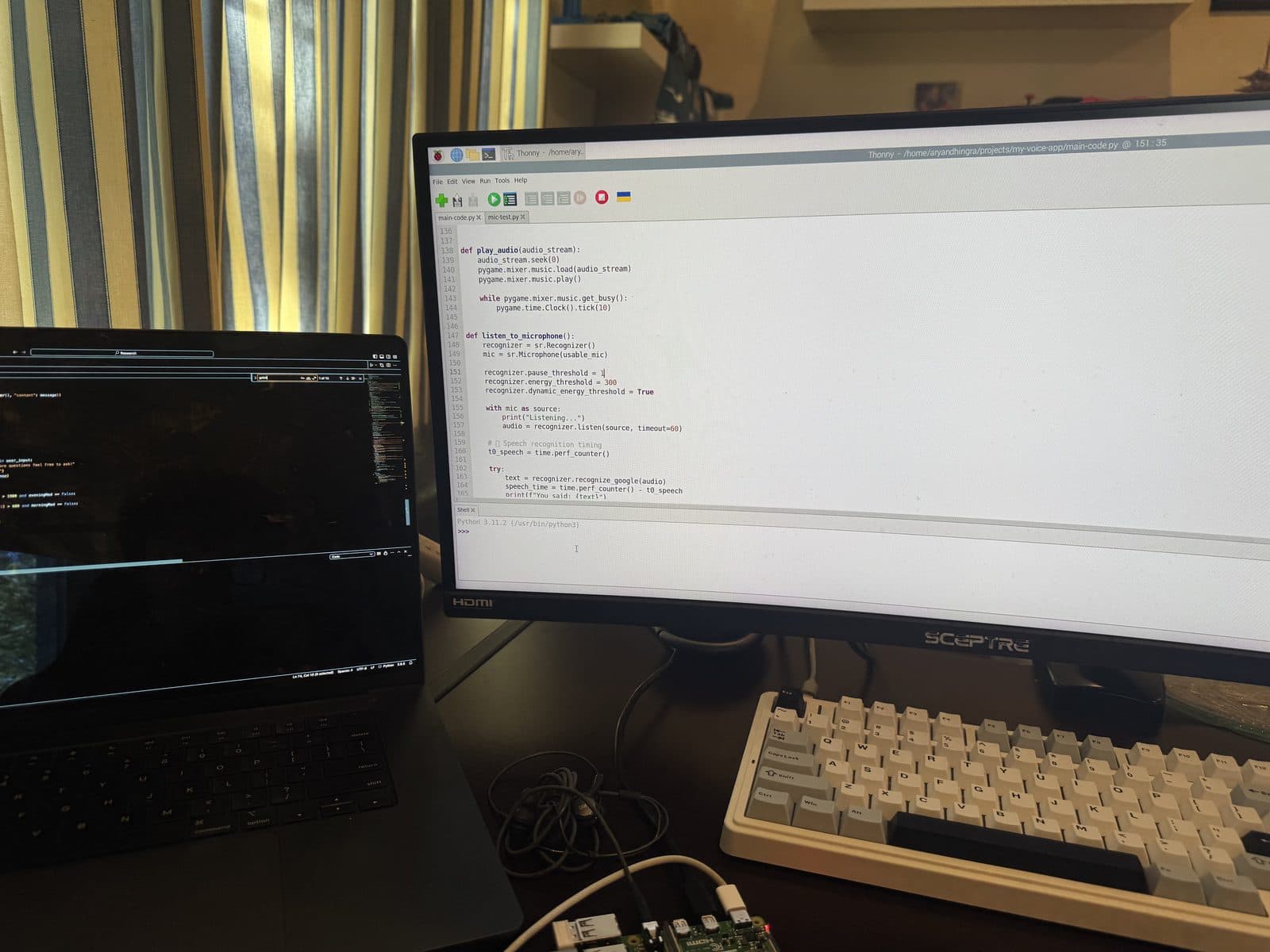
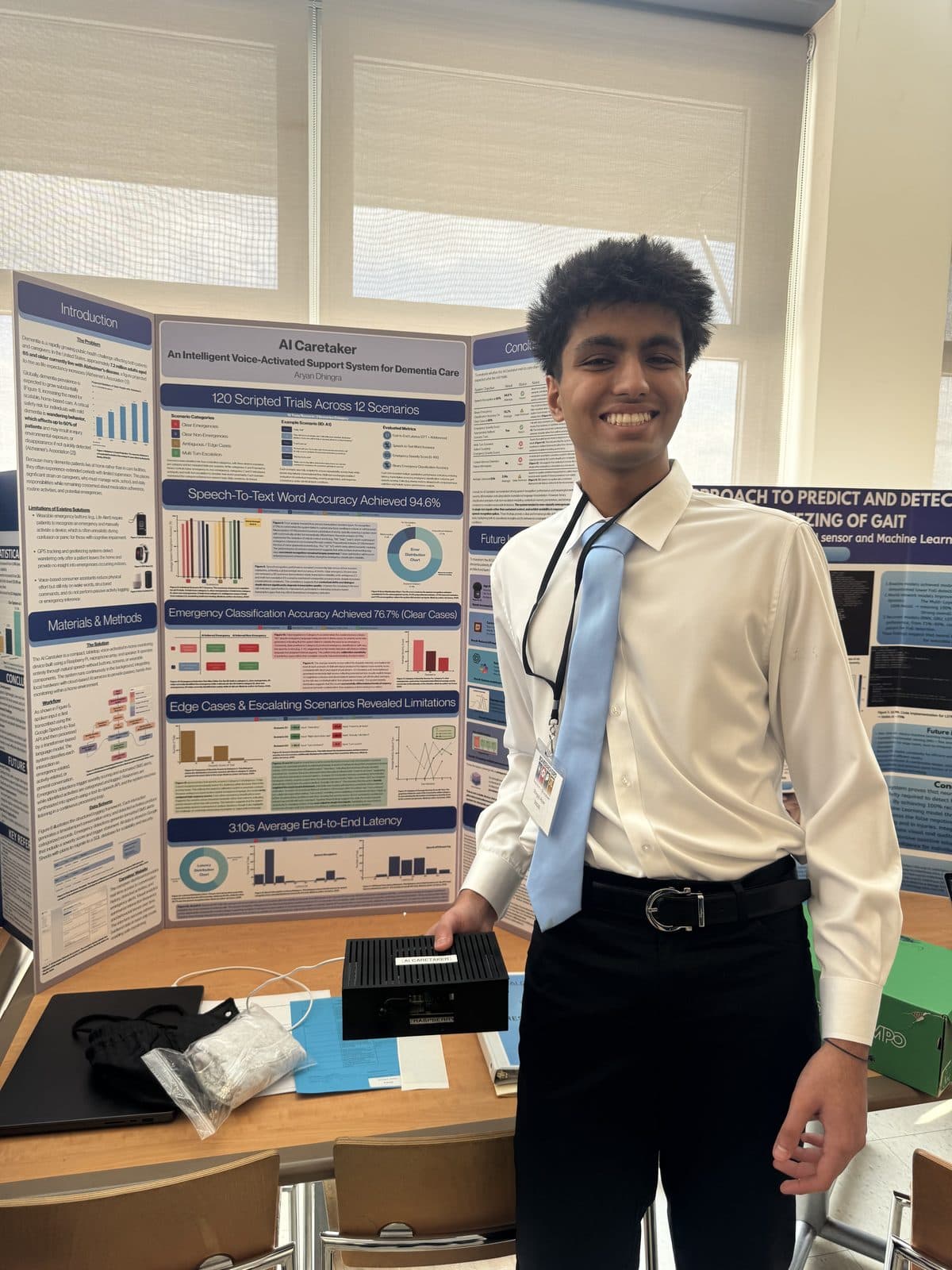
A Raspberry Pi 4B tabletop device captures speech and transcribes it on-device, with recognition tuned for the slow, hesitant, fragmented speech common in dementia.
Understand
A cloud backend retrieves the last ~5 minutes of conversation for context, then asks GPT-4o-mini for a spoken reply plus a strict JSON block classifying emergency, activity, and medication.
Record
Every statement, reply, and detection is written to a Supabase PostgreSQL database — building both the live context window and a long-term record.
Notify
A positive emergency flag triggers an SMS to the caregiver with severity and transcript; everything else surfaces on the live dashboard.
Under the hood
The design decisions that make conversation a reliable safety signal — not just a chatbot.
Structured output, every turn
The model doesn't just chat — it returns strict JSON on every statement: a conversational reply plus three detection objects (emergency with a flag, type, and 0–100 score; activity with a flag and type; medication with a flag and time of day). That cleanly separates what the patient hears from the machine-readable data the database, alerts, and dashboard run on.
Context-aware memory
A rolling five-minute window of prior statements is fed into every request, so the system reasons over the conversation, not a single sentence. “I feel strange” → “I feel dizzy” → “I can't stand” is read as one escalating emergency, and figurative lines like “that movie almost killed me” are correctly dismissed once context clarifies them.
Tested, not just built
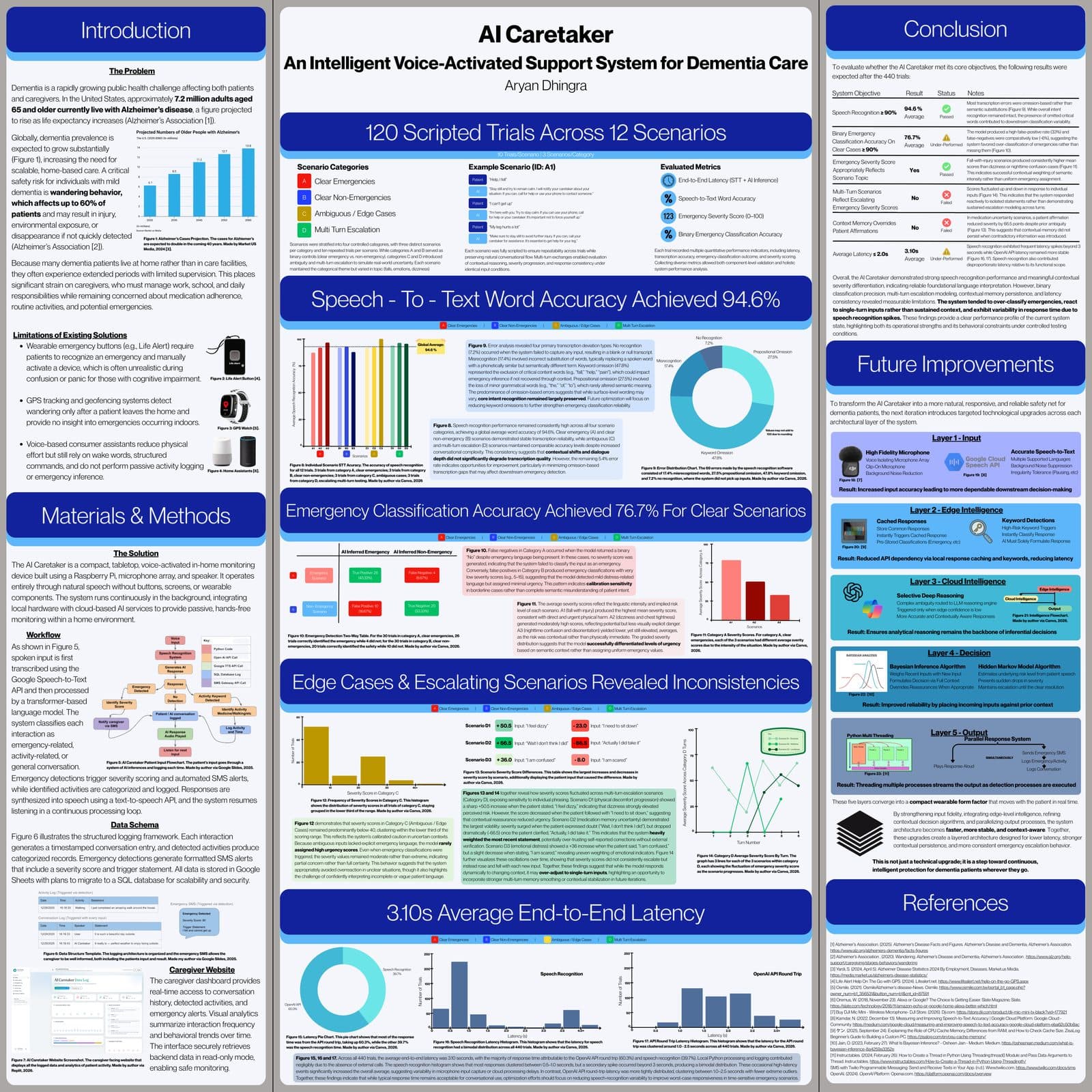
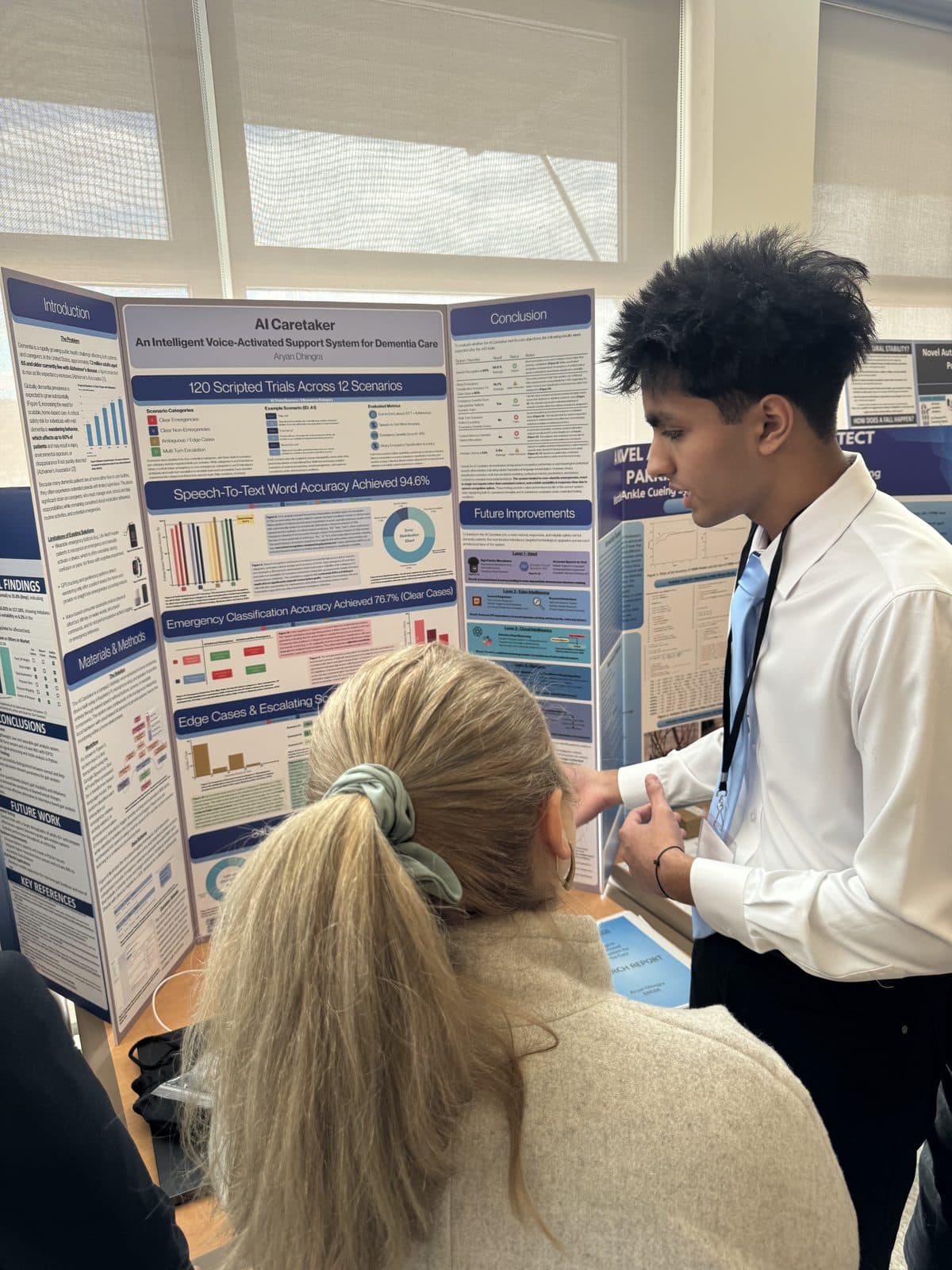
I evaluated the whole pipeline across 12 scripted scenarios — clear emergencies, safe controls, ambiguous edge cases, and extended multi-turn conversations — each run 10 times, for 120 trials and 440 turn-level interactions. It hit 94.6% speech-to-text accuracy, and the study surfaced exactly where to improve next: alert calibration and temporal reasoning.
Tested, measured, and written up.
AI Caretaker isn't just a prototype — it's a documented study. I evaluated it across 12 scripted scenarios and 440 turn-level interactions, and wrote the results into a full research paper.
- 94.6%
- Speech-to-text accuracy
- 120
- Scripted trials (440 turns)
- 3.24s
- End-to-end response time
- Patent
- Pending — U.S. provisional
U.S. Provisional Patent — Filed May 2026
“AI Caretaker: A Voice-Activated In-Home Safety System for Dementia Patients” · Application No. 64/073,388 · Patent Pending.
The build
Be one of the first.
I'm onboarding a small group of beta testers — caregivers, families, and anyone who believes in this mission — to help shape AI Caretaker before launch. Sign up and I'll reach out with early access.
- Early hands-on access
- A direct line to me for requests
- Help decide what gets built next
Tell me everything.
Bugs, wishes, praise, confusion — all of it helps. Whether you've tried the device or just have an idea, your feedback goes straight to me and directly shapes the roadmap.